DIY Tutorial: Upcycle Used Coffee Cups into Unique Wall Lights

DIY Tutorial: Upcycle Used Coffee Cups into Unique Wall Lights

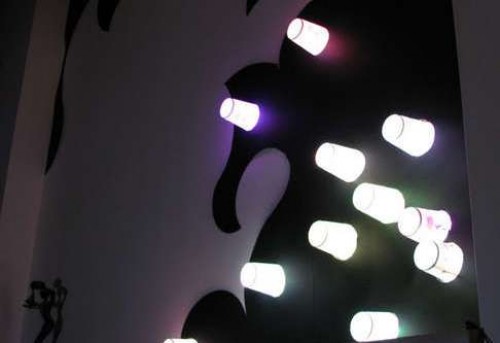
Learn how to upcycle disposable coffee cups into unique decorative wall lights for your home. This DIY tutorial provides a complete list of necessary materials—including paper cups, super bright LED lights (white and multi-color), power adapters, and wiring—along with step-by-step instructions to create your own sparkling light feature.

Do you enjoy a morning coffee? Instead of throwing away those disposable paper or plastic cups, why not transform them into a "one-of-a-kind" lighting system for your room?

With just a few simple steps and a little dexterity, you can create a shimmering, warm atmosphere using items that would otherwise be discarded. Let’s get started on this recycled wall light project right now!

1. Preparation: Materials and Tools

To ensure a smooth process, you need to prepare the following items. Most of these are easy to find or may already be available in your home.
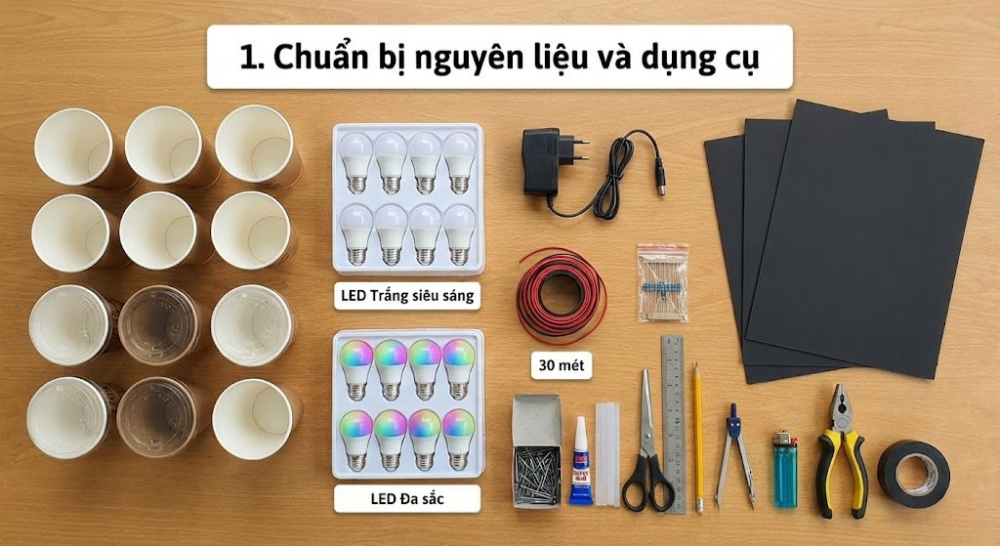
Essential Materials:

  • 12 Coffee Cups: You can use paper or plastic cups (Note: wash thoroughly and dry before use).
  • LED Lights:
  • 12 White LEDs (super bright type).
  • 12 Multi-color LEDs (7-color or 4-color) to create shimmering effects.
  • Power Source: 1 x 3V Power Adapter.
  • Electrical Wire: Approximately 30 meters of thin wire (adjust the length according to your wall size).
  • Resistors: Choose resistors compatible with a 3V source and your specific LEDs (you can use an online resistor calculator to find the right ohm value).
  • Cardstock: 4 sheets of black cardboard (approx. 50x70 cm) to create a background or hide wires.
  • Miscellaneous: About 30 small nails, adhesive (hot glue or super glue).

Tools:

  • Scissors, ruler, pencil.
  • Compass (for drawing circles).
  • Lighter (used for stripping wire insulation or heating hot glue sticks).
  • Other tools: Pliers, electrical tape, etc.

2. Step-by-Step Instructions

Step 1: Prepare Cups and Install LEDs

  • Use a sharp object or an awl to punch a small hole in the exact center of the bottom of the cup.
  • Thread the LED bulb into the cup.
  • Solder a resistor in series to the LED leg to protect the bulb from burning out when connected to the power source.
  • Pro Tip: You can install two bulbs (1 white, 1 colored) in parallel within a single cup to switch between two different lighting modes.

Step 2: Positioning and Wall Mounting

  • Determine where you want to hang the lights on the wall. Use a pencil to sketch the desired shape (e.g., a heart, a spiral, or a random arrangement).
  • Hammer nails into the marked positions. Ensure the spacing between nails is even for the best aesthetic result.

Step 3: Wiring and Testing

  • Hang the cups with installed LEDs onto the nails.
  • Proceed to connect the wires between the cups and connect the circuit to the 3V power adapter.
  • Important: Once wired, plug it in to test immediately. Check if both modes (white light and multi-color) are lighting up evenly. If any bulb fails to light up, check the connections or replace the bulb immediately.

Step 4: Decorative Masking

To make the lamp look professional and tidy, use the black cardboard to hide the messy wiring.
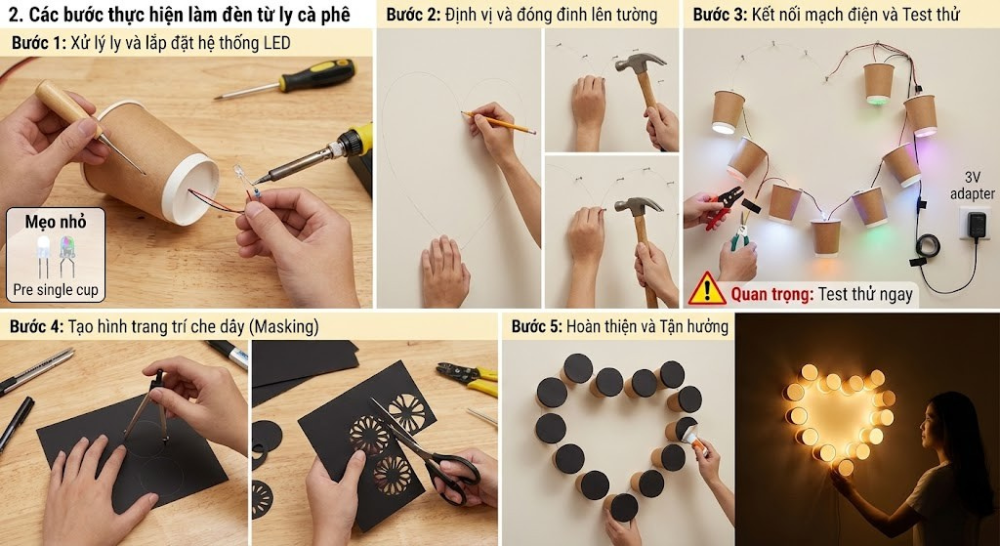
  • Use a compass to draw circles on the black cardboard that fit the bottom of the cup (or slightly larger to create a border).
  • You can cut additional patterns into the cardboard to create beautiful light projection effects.

Step 5: Completion and Enjoyment

  • Glue the cut cardboard pieces onto the wall or the bottom of the cups to conceal wire joints and nail heads.
  • Straighten and secure the wires neatly.
  • Plug it in, dim the room lights, and enjoy the shimmering result created by your own hands!

3. Important Safety Notes

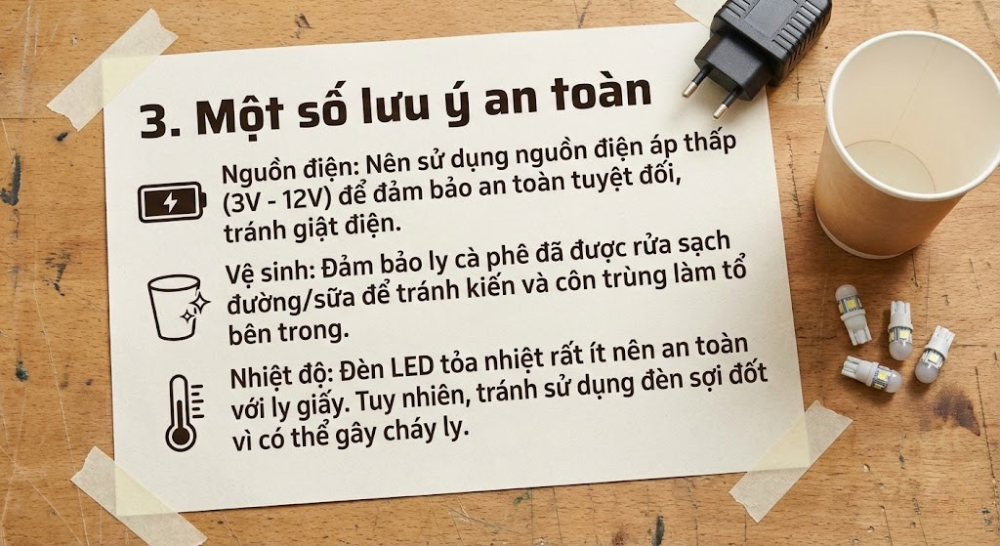
  • Power Source: Always use a low-voltage power source (3V - 12V) to ensure absolute safety and avoid electric shock.
  • Hygiene: Ensure the coffee cups are completely cleaned of sugar and milk residues to prevent ants and insects from nesting inside.
  • Temperature: LEDs emit very little heat, so they are safe for paper cups. Do not use incandescent bulbs, as they generate high heat and can cause the cups to catch fire.

Comment & review

Please enter content....

Latest

Economic Benefits of Switching from Plastic to Paper Cups

Economic Benefits of Switching from Plastic to Paper Cups

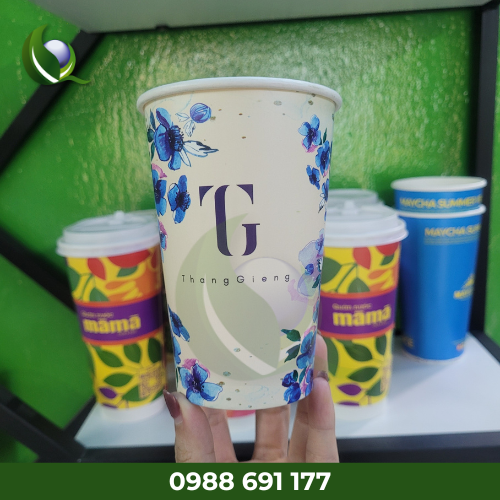
Switching from plastic to paper cups is a smart investment strategy that helps F&B businesses not only optimize operational costs but also build a sustainable brand image and attract a large customer base that values environmental responsibility. This is no longer just an option—it’s a strategic move to assert market position and increase competitiveness in an increasingly demanding landscape.
Read more

Read more

Paper Cups and the Shift in Vietnamese Consumer Habits

Paper Cups and the Shift in Vietnamese Consumer Habits

Paper cups and the shift in Vietnamese consumer habits are shaping a greener future—one where every small choice contributes significantly to the environment and public health, while also unlocking golden opportunities for F&B businesses. At Ly Giấy Việt Nam, we see this transition as an inevitable wave, offering an optimal solution for both consumers and brands aiming for sustainable...
Read more

Read more

Paper Bowls for Hot Dishes: The Ideal Solution for Pho, Noodle Soup, and More

Paper Bowls for Hot Dishes: The Ideal Solution for Pho, Noodle Soup, and More

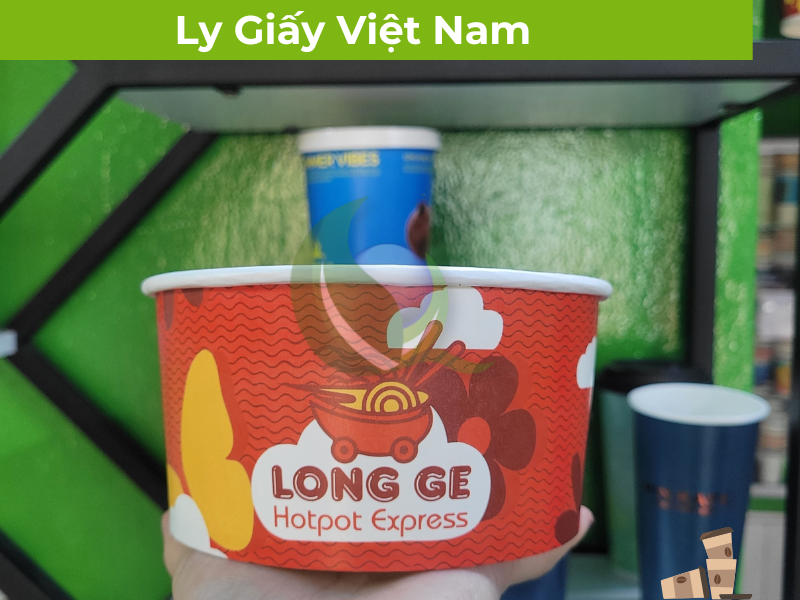
Paper Bowls: The Ideal Solution for Hot Dishes Like Pho, Noodle Soup, and Broth More than just a packaging trend, paper bowls are a strategic decision that enhances customer experience and strengthens brand value in the highly competitive food delivery market. Ly Giay Vietnam is proud to offer high-quality paper bowl products that fully meet the criteria of safety, aesthetics, and business...
Read more

Read more

Trends in paper usage in the F&B (Food & Beverage) industry

Trends in paper usage in the F&B (Food & Beverage) industry

The trend of using paper cups in the F&B (Food & Beverage) industry is not just a temporary trend but has become a green revolution, reshaping the entire appearance of the modern food and beverage industry.

Read more

Read more

Paper cup production process meets food safety standards.

Paper cup production process meets food safety standards.

The process of producing paper cups that meet food safety standards is a series of complex stages, requiring precision and strict compliance with food safety regulations

Read more

Read more

How to Attract Customers with Eye-Catching Packaging: A Crucial Topic in Building and Growing a Brand

How to Attract Customers with Eye-Catching Packaging: A Crucial Topic in Building and Growing a Brand

How to attract customers with beautiful packaging is a very important topic in building and developing a brand.

Read more

Read more